

As each year passes, a portion of the patent reclassifies to an amortisation expense. In order for an asset to be depreciated for tax purposes, it must meet the criteria set forth by your country’s taxation office. Having an asset lose value can actually be a good thing for a business because it can allow for future tax deductions. Whether it’s a single computer and a desk or a fleet of trucks and a helicopter, every business needs to have assets in order to function.
What is an Asset?
Recognizing which assets are subject to depreciation ensures that your business’s financial records accurately represent the value of your assets over time. This knowledge empowers you to make informed decisions about asset management, tax planning, and overall financial strategy for your business. Understanding which assets are subject to depreciation is crucial Debt to Asset Ratio for business owners. This knowledge helps accurately account for business expenses and maintain proper financial records. Tax depreciation follows a system called MACRS, which stands for modified accelerated cost recovery system.

Step-by-Step Calculation Process

This formula will give you greater annual depreciation at the beginning portion of the asset’s useful life, with gradually declining amounts each year until you reach the salvage value. At the end of the reporting period, the business will claim depreciation expense for any relevant assets using one of the accepted methods. Notably, depreciation is often considered a “non-cash expense” because it doesn’t reflect actual cash flows in the years following the initial purchase.
Accumulated Depreciation and Depreciation Expense: A Complete Guide
In DDB depreciation the asset’s estimated salvage value is initially ignored in the calculations. However, the depreciation will stop when the asset’s book value is equal to the estimated salvage value. After the financial statements are distributed, it is reasonable to learn that some actual amounts are different from the estimated amounts that were included in the financial statements.
To claim Section 179, you must use the property more than 50% of the time during regular business operations. Take a depreciation deduction on your tax return by attaching Form 4562, Depreciation and Amortization, to your tax return. Physical depreciation results from wear and tear due to frequent use and/or exposure to elements like rain, sun and wind. When an asset is sold for less than its Net Book Value, we have a loss on the sale of the asset. We are receiving less than the truck’s value is on our Balance Sheet. GAAP encompasses a set of standards that govern the intricacies, complexities, what is a depreciation expense and…
- For example, a company will have a Cash account in which every transaction involving cash is recorded.
- If you plan to sell the asset before the end of its useful life, an accelerated method might better reflect its declining value.
- Most companies use a single depreciation methodology for all of their assets.
- Depreciation is an accounting method used to calculate the decrease in value of a fixed asset while it’s used in a company’s revenue-generating operations.
- The net book value of each asset is calculated by subtracting the accumulated depreciation from the purchase price.
- The IRS provides guidelines for calculating depreciation expense, including the types of assets eligible for depreciation and the methods allowed.
- Investors should be wary of overstated life expectancies and scrap values.
- This helps you plan for future purchases and understand how depreciation will impact taxable income and cash flow.
- To find out how long you can depreciate assets, review the IRS’s Publication 946, How to Depreciate Property.
- The depreciation rate is defined by the usage of the asset over its useful life.
- This formula is best for companies with assets that lose greater value in the early years and that want larger depreciation deductions sooner.
- Assets that don’t lose their value, such as land, do not get depreciated.
Five months in the first year, 12 months in years two through five, and seven months in year six. In other words, if an asset has a five year useful life, depreciation expense is recorded in each of those five years. More specifically, one year of depreciation is further divided into 12 increments and each increment is recorded as an adjusting journal entry each month. The adjusting entry will be done as part of the closing of the accounting records for the current month. For businesses that record depreciation once a year, the adjusting journal entry will be dated for the last day of the tax year.
Important Depreciation Terms
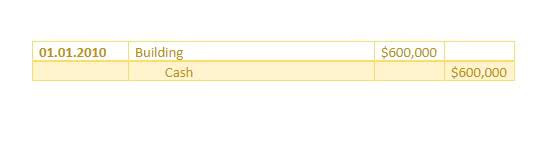
Think about your long-term intentions for the asset when selecting a depreciation method. If you plan to sell the asset before the end of its useful life, an accelerated method might better reflect its declining value. The depreciation expense amount changes every year because the factor is multiplied with the previous period’s net book value of the asset, decreasing over time due to accumulated depreciation. For example, Company A purchases a building for $50,000,000, to be used over 25 years, with no residual value.
- The straight-line method assumes that an asset loses its value evenly over its useful life.
- High-output periods show higher depreciation expense; slow periods show less, aligning cost with revenue.
- If you own a building that you use to make income, you can claim the depreciation on this property.
- The double declining balance method is often used for equipment when the units of production method is not used.
- The most common declining balance percentages are 150% (150% declining balance) and 200% (double declining balance).
- Patriot’s online accounting software lets you complete your books in a few simple steps.
This reflects the reality that many assets lose value faster in their initial https://www.bookstime.com/ years of use, such as vehicles or electronics. In Excel, set up a table to track each asset’s purchase price, annual depreciation expense, and accumulated depreciation. Use the formula for your chosen depreciation method (e.g., straight-line or double declining balance) to calculate the annual depreciation expense for each asset.
- This knowledge forms the foundation for exploring various methods of calculating depreciation, each with its own unique advantages and applications.
- Examples include cash, investments, accounts receivable, inventory, supplies, land, buildings, equipment, and vehicles.
- For example, an asset that costs $100,000 with $40,000 accumulated depreciation has a net book value of $60,000.
- (In the example above, the asset’s book value is $0 in Year 5. The asset is fully depreciated in Year 5).
To offset the asset’s declining value with its cost, you can depreciate the expense. Depreciation expense is recorded to allocate costs to the periods in which an asset is used. A depreciation expense arises due to the reduction in value of a long term asset as a result of its limited useful life. If we expensed capital assets, we would be recording all of the expenses for an asset that will last five plus years in the year of the purchase. When an asset is put in service in any month other than January (or first month of a fiscal year), a business takes depreciation only for the months the asset was owned. To calculate the amount of depreciation, take the calculated amount for the year, divide it by 12 to get the monthly expense, and multiply that number by the number of months the asset was owned.